Anjuman Yaadgar e Rauf

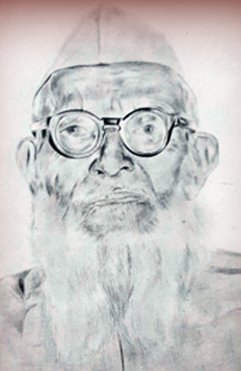
Rauf Amrohvi
(1894 – Dec. 16, 1986)
Alhaj Mirza (Master) Hafiz Abdur Rauf popularly known by the pen name of Rauf Amrohvi (born 1894 – Dec. 16, 1986) was an Urdu poet, best known for his remarkable work in the genre of ‘Na’atiya Shayari’ (poetry in praise of the Prophet (pbuh)). He is one amongst the few Na’atgo poets who are included in the syllabus of the Urdu literature.
Master Rauf was born in the town of Amroha in Uttar Pradesh, India. His father, Mirza Shafi Ullah Beg was a government servant. His primary education started with the memorization of Qur’an (Hifz-e-Qur’an), which he began at an early age. After the completion of his Islamic education, he was admitted into a school in Amroha from where he finished his Metric examination. Later on, he went to M.A.O. College (now Aligarh Muslim University) to complete his higher studies. In 1920, after the completion of his studies, he was offered a teaching position at the Imam’ul Madaris Inter College, Amroha, where he taught Mathematics and English; and it is from here that he gracefully retired at the end of his academic career.
Rauf Amrohvi was an extremely talented polyglot who held command over not just Urdu and English but Persian and Arabic as well. He was an avid reader, and he had particular literary interest in the works of Hafiz Shirazi, Maulana Rumi, Fakhruddin Iraqi, Amir Khusro and Mirza Ghalib. Interestingly, he often used to say that when it came to poetry he had only two and a half favorite poets; namely, Hafiz, Rumi and the half that was Ghalib’s poetry in the Persian language.
He started composing poems in Urdu language at a very early age and some of his oldest works seem to be dated from as early as 1915, if not before. During the beginning of his attempts at literary composition he was mentored by the great Urdu poet Jigar Moradabadi, who praised and gave comments on various ghazals composed by Rauf Amrohvi.
Some of the Books of poetical compositions by him include:
- LakhLakhe Mohamid – Na’at-o-Manaqib
- First edition 1940
- Second edition 1964
- Third edition 1969
- Gul Rang-e-Takhay’yul - Ghazaliya’at
- First edition 1941
- Second edition 1945
- Kausar-e-Rehmat – Na’at-o-Manaqib and Ghazaliya’at
- First edition 1955
- Second edition 1957
- Third edition 1999
- Apni Zubaan se Main – Autobiographical account
- First edition 1978
- Second edition 1986
Rauf Amrohvi was a very pious and spiritual man and was a devout disciple of the sufi saint Qutub Hazrat Shah Himayat-ullah sb. (R.A.) Under the guidance of his Qutub, he established a trend where he would organize a weekly programme of Na’at recitation or Jalsa-e-Na’at Khwani on every Friday which would begin after the Jum’ah prayer and continue till the A’sr prayer time. In addition to this, Rauf Amrohvi also established two annual events; one is a Majlis which is held every year on the event of Ashura-e-Muharram and another is a Milaad which marks the annual celebration of Youm-un-Nabi. All these together constitute almost 54 Mehfils every year. One of the most remarkable and cherished aspect of the legacy left behind by Rauf Amrohvi is that, all these Mehfils have continued to be organized with the same fervor and enthusiasm and without any interruption and lapse since the year 1923 till date Alhamdolillah! And Insha Allah, it shall continue as a trend till Allah wills it.
One of the greatest rewards that Rauf Amrohvi perhaps, received came in the form of his Haj and Medina pilgrimage. A story which is rather well accounted in the memory of the people as nothing short of a miracle (karamat) relates that his religious pilgrimage came forth through the desire of the Prophet (pbuh) himself, who working through the medium of a resident of Medina’tul Munawwara who was hitherto unknown to Rauf Amrohvi and who himself also didn’t know Rauf sb. However, he was the one who invited Rauf Amrohvi to come and perform the Haj and pay his respects at Medina in 1977.
In his personal life, Rauf Amrohvi had to face many hardships. His first three wives did not survive for long and succumbed to death very early on in his life. He found a rather steady partner in his fourth wife Mohammadi Begum, who was a very pious and devoted lady. She left this world for the heavenly abode in 1981. Rauf Amrohvi’s legacy has been taken forward by his children. While his first two wives passed away before they could bear him any children.
He had two sons from his third wife and six children from his fourth:
- Mohammad Husain (1926-1950)
- Ahmed Husain ‘Saifi Amrohvi’ (1931-2011) – He authored two books on poetry namely, Lahu Rang on Ghazaliya’at and Nakh’hate on Na’at-o-Manaqib.
- Hamid Husain ‘Hamid Amrohvi’ (born 1936) – He has authored seven books up until now on Na’at-o-Manaqib. Some of these are Midh’hat ke phool, Khayaban-e-Iram and Juebare Bakhshish amongst others.
- Hamida Begum (1938-1985) married to Late Nawabzada Khalid Husain Khan sb.
- Saida Begum (born 1940) married to Late Khursheed Ahmed sb.
- Sajid Husain ‘Sajid Amrohvi’ (born 1943) – He is a well known poet of Urdu ghazal and Na’at-o-Manaqib whose compositions are compiled in his works like Raaz-e-Bakhshish, Aarzoo-e-Bakhshish, Dast’ras and so on and so forth.
- Taiba Begum (1945-2005) married to Late Mirza Shuja-ur Rehman sb.
- Prof. Asif Husain (born 1948)
Rauf Amrohvi passed away on Dec. 16, 1986 and considering the level of his devotion and love for the Almighty, he found the perfect resting place near the Dargah of Hazrat Shah Sharaf-ud-din Suhrawardi (R.A.) ‘Shah-e-Wilayat’ in Amroha, India.
He wrote the following couplet commenting on his final resting place during his life itself:
- Yahin se naghma’ha’aye na’at ki lehrein si uth’ti hain,
- Rauf-e-za’ar ki turbat yahin ma’aloom hoti hai.
After he had passed away, Janab Shamim Naqvi Amrohvi composed the following couplets in his memory and particularly on his death:
- “Midh’hat-e Mustafa karte karte Shamim,
- Unki mehfil mein a pahunche Abdur Rauf,
- Di yeh rizwan ne khuld-e bari se sada’a,
- Qasr-e jannat mein aa pahunche Abdur Rauf (Hijri 1407)
Composed by: Zoony Zainab